Load Geometry Guide
Centre Of Gravity In Lifting
How centre of gravity affects crane-hook position, load balance, lifting-point reactions and the selection of lifting beams, spreader beams and frames.
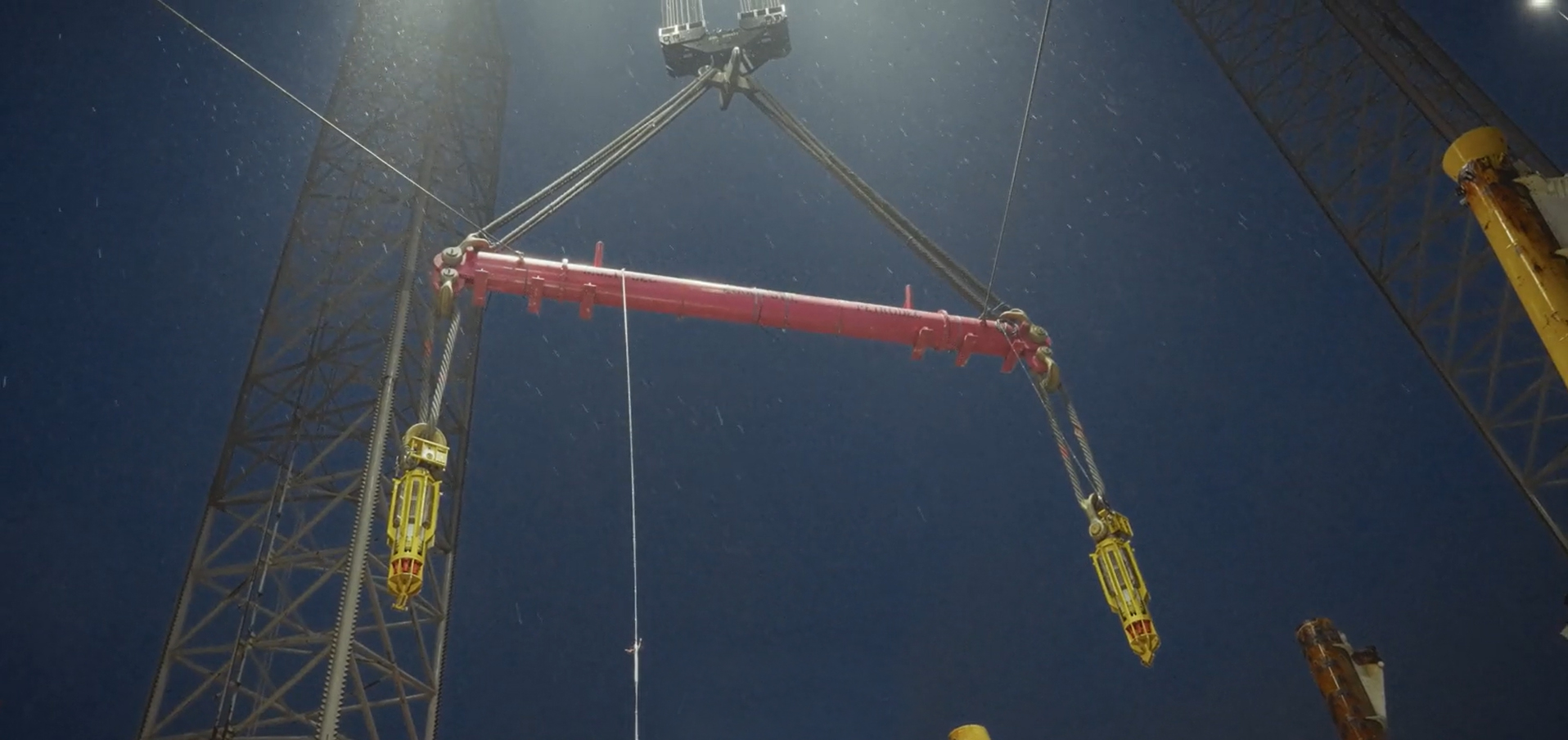
For a stable suspended lift, the crane hook and resultant lifting force need to be positioned so the load can hang with its centre of gravity beneath the suspension system. If the centre of gravity is offset, lower lifting-point reactions can become unequal and the beam, frame and rigging arrangement must be selected around that load distribution.
Load Balance
The Hook Must Work With The Actual Load Distribution
A suspended load naturally tries to rotate until its centre of gravity lies below the suspension point or resultant support line. If the lifting arrangement does not account for the real centre of gravity, the load may tilt and individual lifting-point reactions can differ from the values assumed in a symmetric lift.
For a simple two-point lift, an offset centre of gravity means one lifting point can carry more of the load than the other. For a frame or Multi-Point beam, the distribution can be more complex because structural stiffness and rigging lengths also influence how load is shared.
Engineering Inputs
What To Provide For An Uneven Load
- Total load weight and overall dimensions.
- Known centre-of-gravity location or the component weights needed to establish it.
- Coordinates and allowable loads for every intended lifting point.
- Structural drawings showing how the load can accept lifting forces.
- Required orientation during lifting and landing.
- Available headroom and crane-hook arrangement.
- Any requirement for adjustable lifting points or trim.
Dividing the total weight by the number of lifting points is only valid where the engineered system actually produces that distribution. An offset centre of gravity or incompatible rigging geometry can make individual reactions unequal.
Equipment Selection
How Centre Of Gravity Changes The Lifting-System Choice
| Situation | Possible route | Engineering question |
|---|---|---|
| Two widely spaced points with sufficient headroom | Spreader beam | Can the sling geometry and reactions be kept within the approved configuration? |
| Restricted headroom | Lifting beam | Can the upper connection be positioned to support the actual load distribution? |
| Three or more lower points | Multi-Point lifting beam | How are individual lower-point reactions established and controlled? |
| Four-corner load | Lifting / spreader frame | Does the frame geometry match the load and centre of gravity? |
| Variable or unusual geometry | Adjustable or bespoke solution | Can lifting interfaces be positioned without exceeding any approved limit? |
Frequently Asked Questions
Common Questions
Why does centre of gravity matter when choosing a lifting beam?
Because the position of the centre of gravity affects how load is shared between lifting points. An offset centre of gravity can create unequal reactions that must be considered in the beam and rigging design.
Can an uneven load be lifted with a standard beam?
Sometimes, but only where the approved configuration and rigging arrangement can safely accommodate the actual load distribution. Uneven or uncertain loads may require engineering review.
What information helps assess centre of gravity?
Useful information includes total load weight, dimensions, component weights, lifting-point locations, drawings, known centre-of-gravity coordinates and the proposed crane and rigging arrangement.
Engineering Support
Need Help With A Real Lift?
Send the load, span, lifting points, available headroom and any drawings. Multisec can review the requirement and identify the most suitable standard or bespoke route.