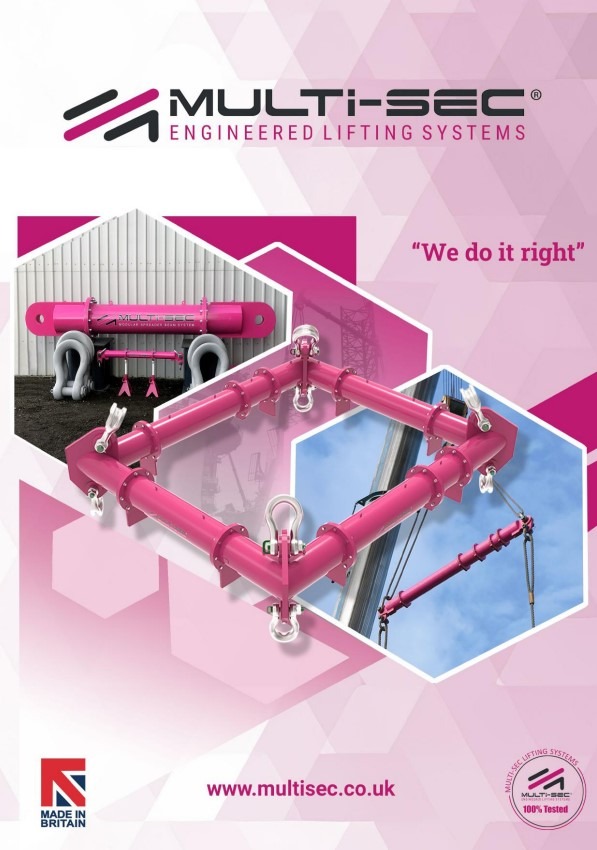
Equipment Selection Guide
How To Choose A Lifting System
A practical way to narrow a lifting requirement from load and lifting-point geometry to the most relevant beam, spreader or frame route without guessing from headline capacity alone.
By Multisec · Purchasing and engineering guidance

Start with the load, lifting-point layout, required span, available headroom and crane connection. Those inputs normally determine whether the first route to review is a lifting beam, spreader beam, lifting frame or a project-specific engineered solution.
Start With The Lift
Five Inputs Narrow The Equipment Route
Before comparing products, define the load weight, lifting-point positions, required span, available headroom and the crane or hook connection. Add the environment and any project certification requirements where they affect the lift.
| Input | Why it matters |
|---|---|
| Load weight | Establishes the required WLL once the actual configuration and load distribution are known. |
| Lifting points | Shows whether the load is supported along one axis, at multiple points or across a rectangular footprint. |
| Span | Influences the available approved configuration and the forces in a spreader arrangement. |
| Headroom | Can make a compact lifting-beam arrangement more suitable than long upper slings. |
| Project requirements | Environment, certification, transport and repeated-use requirements can change the most suitable route. |
Compare The Main Routes
Beam, Spreader Or Frame?
Lifting beam
A lifting beam is commonly reviewed where a compact upper connection, restricted headroom or multiple lower lifting points are important. The beam carries bending and the approved arrangement must match the load geometry.
Spreader beam
A spreader arrangement uses upper slings and a spreader member to keep lifting points apart. It is commonly used for long or wide loads where sling geometry and load distribution matter.
Lifting or spreader frame
A frame is often the first route to review where the load needs controlled support in two directions, such as four corner lifting points on a rectangular module.
When Standard Equipment Does Not Fit
Use The Geometry To Identify A Bespoke Requirement
Non-standard lifting-point positions, offset centre of gravity, unusual headroom, high-capacity requirements or project-specific certification can move the requirement outside a standard product range. In those cases, send the load and drawings for an engineering review rather than forcing the lift into an unsuitable standard arrangement.
Do not select equipment from capacity alone. Use the approved technical data for the actual model and configuration, and refer any unlisted arrangement for technical review.
Prepare The Enquiry
Send Enough Information To Review The Real Lift
Include the load weight and dimensions, lifting-point spacing, available headroom, crane connection, known centre-of-gravity information, environment and required date. Attach drawings where they are available and clearly mark estimates or information still to be confirmed.
Frequently Asked Questions
Common Questions
Should I choose equipment by tonnage first?
Capacity matters, but the equipment also has to suit the span, lifting-point geometry, sling arrangement, headroom and approved configuration. Headline tonnage alone is not enough.
When is a lifting frame more suitable than a beam?
A frame is often the first route to review when the load needs controlled support at four points or across dimensions in two directions rather than along one main beam axis.
What information should I send Multisec?
Send the load weight, dimensions, lifting-point locations, available headroom, crane or hook information, environment, required date and any drawings already available.
Engineering Support
Need Help With A Real Lift?
Send the load, span, lifting points, available headroom and any drawings. Multisec can review the requirement and identify the most suitable standard or bespoke route.