Lifting Beam Guide
Types Of Lifting Beams
Understand the main lifting-beam arrangements used for restricted headroom, multiple lower pick points, unusual load geometry and heavy project lifting.
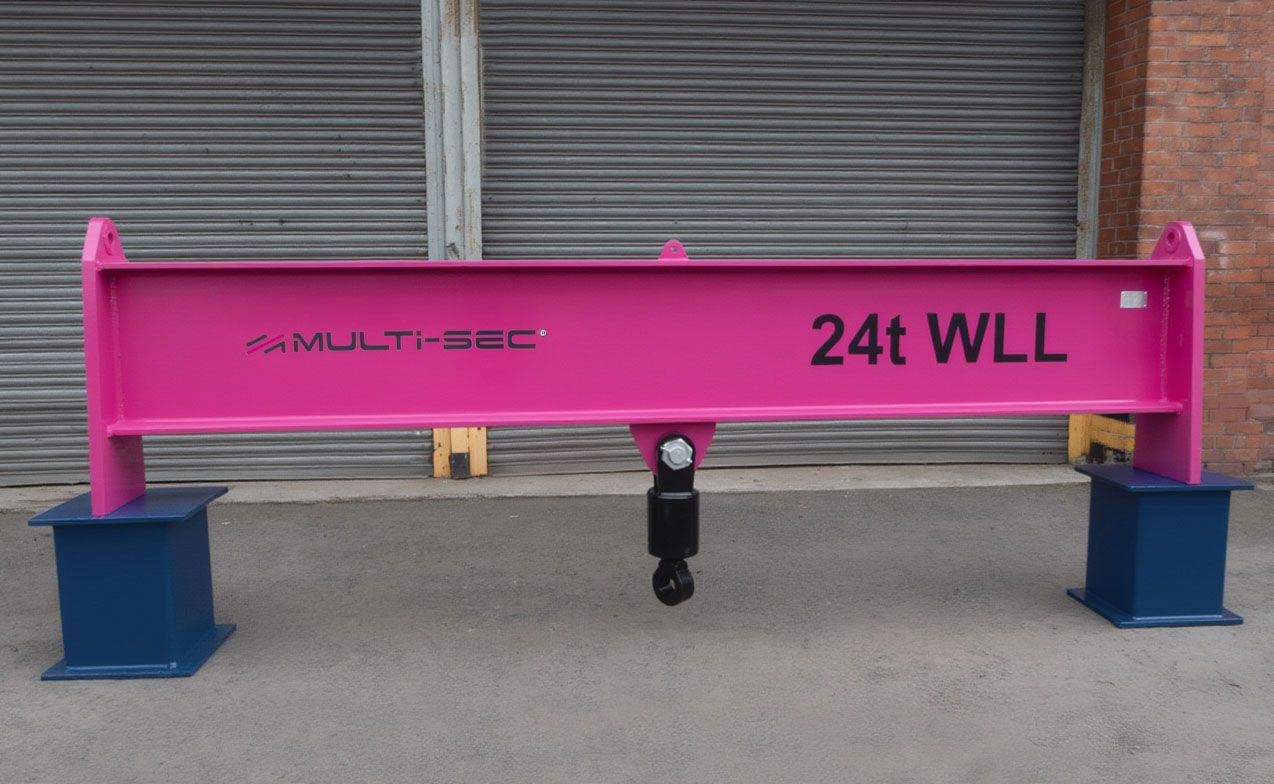
Lifting beams are not one single configuration. The right type depends on the number and position of lower lifting points, available headroom, span, centre of gravity, crane connection and whether a standard beam can match the load geometry.
Main Arrangements
Five Lifting-Beam Routes
| Type | Best suited to | Key selection point |
|---|---|---|
| Centre-point lifting beam | Compact upper rigging and restricted headroom | Beam bending and lower pick-point reactions |
| Multi-Point / Multi-Lug beam | Three or more lower pick points, fabricated or uneven loads | How load is shared between lower connections |
| Semi-spreader arrangement | Applications needing a balance between compact headroom and spread rigging | Approved upper connection geometry |
| Spreader arrangement | Longer spans or wider loads where top slings can be used | Sling angle, compression and available headroom |
| Bespoke lifting beam | Unusual geometry, high capacity or non-standard crane arrangements | Project-specific engineering and verification |
Multi-Point Beams
When Multiple Lower Pick Points Matter
A Multi-Point lifting beam is designed to support the load at several lower positions rather than relying on only two end connections. This can be useful for long fabricated structures, assemblies with several designed lifting points, or loads where support must be distributed to control deflection or local loading.
Multisec Multi-Point beams can be configured in different approved arrangements. The correct arrangement depends on WLL, beam span, lower pick-point positions and the available upper rigging geometry.
The centre of gravity, stiffness of the lifted structure, rigging lengths and connection geometry can all change individual point reactions. Where load sharing is critical, use verified engineering rather than assuming an equal split.
Selection
Choose The Beam Around The Lift
- Start with load weight and required WLL.
- Map every lower lifting point and its allowable load or interface.
- Confirm the span and available crane-hook-to-load headroom.
- Identify the centre of gravity and any expected unequal reactions.
- Confirm the crane hook, upper rigging and sling-angle constraints.
- Check whether an approved standard configuration covers the requirement.
- Move to bespoke engineering where geometry, capacity or certification falls outside the standard range.
Frequently Asked Questions
Common Questions
Which lifting beam type is best for restricted headroom?
A lifting beam with a compact upper connection can reduce the vertical rigging space required above the load. The exact arrangement depends on WLL, span, crane hook geometry and lower pick points.
What is a Multi-Point lifting beam?
A Multi-Point lifting beam distributes support across several lower lifting points. It is useful for fabricated structures, uneven loads and loads that require support at more than two positions.
When is a bespoke lifting beam required?
A bespoke beam may be required when capacity, span, lifting-point geometry, headroom, crane arrangement, environment or certification cannot be met by a standard approved configuration.
Engineering Support
Need Help With A Real Lift?
Send the load, span, lifting points, available headroom and any drawings. Multisec can review the requirement and identify the most suitable standard or bespoke route.